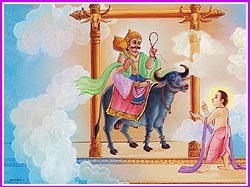
The Kenopanishad derives its name from the first word Kena, meaning ‘by whom’.
1
The disciple asked: Om. By whose will directed does the mind proceed to its object? At whose command does the prana, the foremost, do its duty? At whose will do men utter speech? Who is the god that directs the eyes and ears?
2
The teacher replied: It is the Ear of the ear, the Mind of the mind, the Speech of speech, the Life of life, and the Eye of the eye. Having detached the Self from the sense-organs and renounced the world, the Wise attain to Immortality.
3-4
The eye does not go thither, nor speech, nor the mind. We do not know It; we do not understand how anyone can teach It. It is different from the known; It is above the unknown. Thus we have heard from the preceptors of old who taught It to us.
5
That which cannot be expressed by speech, but by which speech is expressed-That alone know as Brahman, and not that which people here worship.
6
That which cannot be apprehended by the mind, but by which, they say, the mind is apprehended-That alone know as Brahman, and not that which people here worship.
7
That which cannot be perceived by the eye, but by which the eye is perceived-That alone know as Brahman, and not that which people here worship.
8
That which cannot he heard by the ear, but by which the hearing is perceived-That alone know as Brahman, and not that which people here worship.
9
That which cannot be smelt by the breath, but by which the breath smells an object-That alone know as Brahman, and not that which people here worship.
Chapter II
1
The teacher said: If you think: "I know Brahman well," then surely you know but little of Its form; you know only Its form as conditioned by man or by the gods. Therefore Brahman, even now, is worthy of your inquiry.
2
The disciple said: I think I know Brahman. The disciple said: I do not think I know It well, nor do I think I do not know It. He among us who knows the meaning of "Neither do I not know, nor do I know"-knows Brahman.
3
He by whom Brahman is not known, knows It; he by whom It is known, knows It not. It is not known by those who know It; It is known by those who do not know It.
4
Brahman is known when It is realised in every state of mind; for by such Knowledge one attains Immortality. By Atman one obtains strength; by Knowledge, Immortality
5
If a man knows Atman here, he then attains the true goal of life. If he does not know It here, a great destruction awaits him. Having realised the Self in every being, the wise relinquish the world and become immortal.
Chapter III
1
Brahman, according to the story, obtained a victory for the gods; and by that victory of Brahman the gods became elated. They said to themselves: "Verily, this victory is ours; verily, this glory is ours only."
2
Brahman, to be sure, understood it all and appeared before them. But they did not know who that adorable Spirit was.
3-6
They said to Agni (Fire): "O Agni! Find out who this great Spirit is." "Yes," he said, and hastened to It. Brahman asked him: "Who are you?" He replied: "I am known as Agni; I am also called Jataveda." Brahman said: "What power is in you, who are so well known?" Fire replied: "I can burn all-whatever there is on earth." Brahman put a straw before him and said: "Burn this." He rushed toward it with all his ardour but could not burn it. Then he returned from the Spirit and said to the gods: "I could not find out who this Spirit is,"
7-10
Then they said to Vayu (Air): "O Vayu! Find out who this great Spirit is." "Yes," he said, and hastened to It. Brahman asked him: "Who are you?" He replied "I am known as Vayu; I am also called Matarisva." Brahman said: "What power is in you, who are so well known?" Vayu replied: "I can carry off all-whatever there is on earth." Brahman put a straw before him and said: "Carry this." He rushed toward it with all his ardour but could not move it. Then he returned from the Spirit and said to the gods: "I could not find out who this Spirit is,"
11-12
Then the gods said to Indra: "O Maghavan! Find out who this great Spirit is." "Yes," he said and hastened to It. But the Spirit disappeared from him. Then Indra beheld in that very region of the sky a Woman highly adorned. She was Uma, the daughter of the Himalayas. He approached Her and said: "Who is this great Spirit?"
Chapter IV
1
She replied: "It is, indeed, Brahman. Through the victory of Brahman alone have you attained glory." After that Indra understood that It was Brahman.
2
Since they approached very near Brahman and were the first to know that It was Brahman, these devas, namely, Agni, Vayu, and Indra, excelled the other gods.
3
Since Indra approached Brahman nearest, and since he was the first to know that It was Brahman, Indra excelled the other gods.
4
This is the instruction about Brahman with regard to the gods: It is like a flash of lightning; It is like a wink of the eye.
5
Now the instruction about Brahman with regard to the individual self: The mind, as it were, goes to Brahman. The seeker, by means of the mind, communes with It intimately again and again. This should be the volition of his mind.
6
That Brahman is called Tadvana, the Adorable of all; It should be worshipped by the name of Tadvana. All creatures desire him who worships Brahman thus.
7
The disciple said; 'Teach me, sir, the Upanishad." The preceptor replied: "I have already told you the Upanishad. I have certainly told you the Upanishad about Brahman."
8
Austerities, self-restraint, and sacrificial rites are Its feet, and the Vedas are all Its limbs. Truth is Its abode.
9
He who thus knows this Upanishad shakes off all sins and becomes firmly established in the infinite and the highest Heaven, yea, the highest Heaven.
http://www.ishwar.com/hinduism/holy_upanishads/kena_upanishad/
http://www.vivekananda.net/PDFBooks/upanishads_nikhilananda.pdf
Svetaketu, the son of great and wise man Uddalaka, was twelve years old, he was sent to a teacher with whom he studied until he was twenty-four. After learning all the Vedas, he returned home full of conceit in the belief that he was consummately well-educated, and very censorious.
Father saw his son's pride. "My dear son," he asked, "I wonder if you have learned the wisdom of the Veda. Can you hear what cannot be heard by the ear? Can you see what cannot be seen by the eyes? Do you know what cannot be known by the mind?"
"What do you mean, dear Father?" asked Svetaketu in surprise.
His father replied, "My son, when you know one lump of clay, you know all that is made of clay."
"When you know one nugget of gold, you know all that is made of gold."
"I have not yet learned this teaching," said Shvetaketu humbly. "Please, Father, teach me."
"As you wish, my dear son" said the father
"In the beginning there was a unbounded ocean of consciousness, one without a second(Ekam evaadvitiyam). It thought to itself 'I am one - may I be many,' and created light. Light thought to itself, 'I am one - may I be many,' and created water. Water thought to itself, 'I am one- may I be many,' and created matter. So consciousness became light, water and matter and the three became many and it is the essence of all things. That thou art(tat tvam asi), Shvetaketu."
... And he said, "Bring me a fruit of banyan tree."
Shvetaketu went outside and picked a fig from banyan tree. "Here it is, Father." said Shvetaketu.
"Break it open." said his father. "Tell me, what do you see inside?"
"I see many seeds"
"Break one seed open." said his father. "Tell me what do you see."
"I see nothing at all." said Shvetaketu.
"My son, that 'nothing' is the subtle essence of all living things, which appears as nothing because you cannot perceive it, but the tree has grown, and of that you are created.
"Please, honored Sir, teach me more," said Shvetaketu.
"As you wish, my dear son", said his father. "Place this salt in a glass full of water, and come to me in the morning."
Shvetaketu did this.
Next morning the father said, "Bring me the salt you poured into the water."
The son looked for it, and said "The salt has disappeared, Father."
"Please take a sip from the top of the glass," his father said. "How does it taste?"
"Salty."
"Now pour out some and take a sip from the middle," said his father. "How does it taste?"
"Salty."
"Now pour out some and take a sip from the bottom. Tell me, how does it taste?"
"Salty," said Shvetaketu.
"Even though you couldn't see it, the salt was found in every drop of water. In the same way, pure consciousness is found in all beings. That subtle essence of the whole world, the Self of all that is, the ocean of pure consciousness - that is truth. That is the all-pervading Self. That thou art Shvetaketu."
...And then Shvetaketu understood the true teaching of the veda, and became a famous teacher in the court of King Janaka, Shvetaketu always remained humble, once he had realized the Self, the ocean of pure consciousness.
Source: Chandogya Upanishad
http://books.google.co.in/books?id=BcDlPTSbEoEC&printsec=frontcover#v=onepage&q&f=false
Long ago there was a prince named Hemachuda, who married Hemalekha, the daughter of a sage. He discovered that this beautiful young woman was not interested in worldly pleasures.
When he asked her why, she explained, "The objects that are sources of pleasure cannot be enjoyed forever. No one can have everything he or she desires, and one who gets only a few of those things is not satisfied. In most cases, pleasure is contaminated by suffering. Further, the concept of pleasure is based on one's way of thinking about worldly objects.
Lets us take the example of a beautiful woman. The woman is outside the man who perceives her, but the perceiver brings her image inside and evaluates her beauty. If he decides that she meets his standard of loveliness, he projects his conception of beauty onto her. And as he things about the attractiveness he has projected onto her, this idea is reinfornced. Consequently desire arises, he senses and mind become excited, he beings to experience pleasure. The cause of that excitement is the sense of beauty in his mind. Children who have not yet developed this sense, and yogis who have conquered it, are not aroused even though they see the same woman.
After listening to her elaborations on worthlessness of worldly objects, the prince too lost his interest in them and become dispassionate. Out of habit and hidden desires he was attracted to sense objects, but at the same time, remembering his wife's words, he was repelled. He was constantly upset.
The learned princess realized that her husband had the potential for spiritual growth and lead him on the spiritual path. The first step was to explain that an untrained mind is the root cause of all miseries. 'Mind is like a monkey jumping incessantly," she told him. "In order to comprehend the truth, it is necessary to control its modifications and make it one-pointed, sharp, and inward. Thoughtful consideration enriched with faith and constructive reasoning is vichara. Try to understand the supreme goal with its help. Then make a sincere effort to achieve that goal. If you become skeptical because you do not seem to be making progress, you become your own enemy. But if you make an effort with full confidence, faith, and courage, you can never fail."
The prince replied, "How does this follow the law of karma?"
The princess explained "Law and order are created by Him* and applies only to those who are not fully surrendered to the divine force.
She immediately grants the highest reward of Self-realization to truly selfless devotees. She is an embodiment of infinite compassion, She repeals the law of karma and speedily guides seekers to the highest Self. And after attaining it, their karmic debts are paid. After that, if directed by the supreme divine force, Self-realized aspirants may come back to work in the world and honor the law of karma voluntarily"
The princess went on to describe the nature of the immanent and transcendent forms of God. Inspired by her wisdom, the prince studied with learned masters and gained a clear, intellectual understanding of the truth. With the passage of time he was initiated by his wife and committed himself to the practice of meditation with complete faith and determination.
Now he understood the meaning of inner joy, and compared to that, he found worldly pleasures tasteless. . But at this stage of his spiritual practice he was unable to live in the inner and outer worlds simultaneously.
One day Hemachuda asked his wife to elaborate on the nature of our own true Self. To his disappointment, she simply said, 'Whatever you feel to be yours is without any doubt different from you. So go into solitude, learn to discriminate, and whatever you find to be related to you, distinguish it from your Self and thus realize your true Self. For example, I am your wife; this automatically implies that I am not you. Renounce everything that is yours. The part of you that cannot be renounced is the Self. That you are."
The prince went into seclusion, sat down, and began to think one-pointedly. "Who am I?" he pondered. "This body is not the Self, because it is born and it changes every day. Therefore I cannot be my body. By the same token, I cannot be my prana, senses, mind, or intellect. But even though I do not know who I am and what I am, I feel that I am. I can know things through my mind, but how can I know myself? Let me control all my thought constructs. Then I might experience my pure Self."
Having made this resolution, the prince emptied his mindfield which he had developed in his meditation practice. He was suddenly plunged into great darkness, he controlled his mind, transcended the darkness, and experienced a flash of infinite light. Then the light vanished. "Am I seeing the Self in different forms?" he wondered. "Let me control my mind again and see what is beyond."
This time he slipped into a deep sleep that gradually shifted to the dream state. When he returned to normal awareness he asked himself, "Was all of this a dream? Now I am confused.Were the light and darkness also phases of a dream? What a tricky mind. Let me try once more."
This time the prince crossed the sleeping state and was absorbed in a state of blissful awareness. But eventually his mind slipped back to the ordinary waking state. Then he wondered, "Was this bliss a mere dream, or the experience of truth? I've never experienced such a profound state of peace. There is no joy like it, but I cannot explain it. I was not unconscious, because I still remember it clearly. I know that I have experienced it, but it is still a mystery."
The prince returned to his wife, told her of his experiences, and asked if what he had experienced was the Self or something else. The princess replied, "My lord, the effort you made to control the modifications of your mind was very helpful. Enlightened masters consider this to be the main means of Self-realization.
'Suppose a man hides a piece of gold and then forgets where he hid it. When he stops thinking about other things and concentrates only on the gold, he will find it. He is able to concentrate on the gold because he already knows what it looks like.
In the case of the Self, however, the search is more frustrating because people have completely forgotten that it is their own true nature. That is why they believe they have seen the Self after they have removed some of their thought constructs. An unfamiliar image suddenly arises, and they think 'This is Atman.' That is why they must get some concept of the Self through the revealed scriptures or from the enlightened sages. By so doing they won't mistake the projection of their own mind for the Self while they are in meditation. Enrich your understanding of the Self through self-study, discrimination, and contemplation. For direct realization, however, keep practicing."
So the prince undertook another intense spiritual practice and was finally established in the blissful state. The princess saw that her husband was no longer driven outward by his senses and mind, but drawn inward, and for some time she did not disturb him. Then one day, as she entered the room, the prince opened his eyes, but closed them again to re-enter that peaceful state. His wife caught his hands and asked, "What do you gain or lose by opening and closing your eyes? Do you not want to share your inner experiences?"
The prince replied, "For the first time in my life I am at peace. All my life I have run after worldly pleasures, but found no peace. Please be kind to me: leave me alone. Why, after realizing this state, are you still entangled in the world? Why don't you stay in this state forever? Why dissipate yourself in the external world?"
The wise princess answered with a smile, "My love, you still have not realized that supreme state of the Self. What you think you understand is like no understanding at all. The highest awareness can never be affected by opening or closing your eyes. It is not attained by action or inaction, by going somewhere or staying at home. How can it be supreme if it is attained by closing your eyes and lost by opening them? '
Unless the millions of knots of delusion are loosened, supreme bliss cannot be reached. Failing to recognize the Self or seeing a difference between the individual soul and God are some of these knots. Untie them. Transcend the duality of wanting and not wanting, liking and disliking, and finally, let that supreme awareness permeate your waking, dreaming, and deep sleep. There must be no wall between any of the aspects of life.
"Deflated, the prince continued his spiritual practice. Gradually he attained maturity in his realization and became firm in that consummate state. And after that he lived as a jivanmukta (a soul liberated in this lifetime) while enjoying worldly objects, ruling his subjects, amassing wealth, and administering the kingdom.
Thus Dattatreya demonstrated to Parashurama that the company of the sages is the first step in sadhana and remains the guiding force throughout. Those who aspire to the ultimate should seek the fellowship of saints. The rest follows naturally and effortlessly.
Hemachuda's father and brothers were amazed at the difference in him. He now went about administering the kingdom with tranquility and wisdom, and his relationship with his bride had changed from one of passionate infatuation to profound respect and deep sharing. When his relations asked Hemachuda how he had come to change so much, he taught them just as Hemalekha had taught him.
Now the ministers were impressed at the dramatic change in the royal family, who were suddenly showing a maturity and serenity completely uncharacteristic of them.
And now the people of the kingdom could scarcely believe the transformation in their ministers, who were suddenly tempering their actions with spiritual insight. The people wanted to know how this had happened, and the ministers in turn taught them.
In the end, nothing at all changed: Hemachuda and Hemalekha still loved each other, the king still ruled, the ministers still ministered, the washer men still cleaned the laundry, the cooks still cooked. . . . But everything had changed: all the people went about their business with Self awareness and a profound mutual respect born from their new found recognition that the divine being they had discovered in themselves also existed in every other living thing.
There is an inspiring story in the Kath Upanishad about a little boy named Nachiketa. He was the son of Udalak rishi. Once Udalak organized a yagna to please the deities. It was customary in those days to donate cows to Brahmins at the end of the yagna. Udalak was a miser and he donated old and weak cows to the Brahmins. None of the cows yielded any milk. This disturbed Nachiketa. He asked his father about it, "Father, to whom would you give me in charity?" This made his father very angry, but he decided not to say anything. When Nachiketa repeated the question, Udalak lost his temper and said, "I give you to Yama." Yama is the king of Yamapuri-hell. Hearing this Nachiketa went to Yama's kingdom. It was his father's command. It would not be proper for him to disobey his father. 'I should fulfil his wish,' thought Nachiketa, even if it means leaving home.
However his father realized his mistake and tried to stop him but Nachiketa did not stop. He reached Yama's kingdom and was told by Yama's guards that he had gone out for three days. Nachiketa decided to wait at his doorstep till he returned . He waited for three days. No food, no water. Three fasts ! Yama returned on the fourth day and saw little Nachiketa at his doorstep. He felt pained for keeping a Brahmin waiting without welcoming him, without food and water. It was a sin not to welcome an atithi -guest at the doorstep. He scolded his wife Yami for not welcoming him. Both rushed around the house to serve Nachiketa. One went to fetch water. The other brought a mat for him to sit on. Yama still did not feel completely satisfied in serving him. So he told Nachiketa, " Dear child, I have offended you by keeping you waiting for three days. To wash my sin I request you to ask for three boons."
Nachiketa declared,
"My first wish is, when I return home may my father welcome me lovingly.
My second wish is to grant me the knowledge by which I can be worthy of living in the heavens.
My third and last wish is to grant me Atmagnam -knowledge of the atma ."
Yama granted the first two boons immediately and tried to convince Nachiketa to give up his third wish. He offered him gold, pearls, coins, horses elephants and even the happiness of Swarg -heaven instead. "No, I do not wish for anything else," replied Nachiketa firmly. Finally, Yama granted him the third boon too, and Nachiketa was enlightened with the knowledge of the atma .
Nachiketa inspires us to be kind to all creatures, to respect one's parents, to be strong willed to do something one has decided, even in the face of difficulties and obstacles and to seek for eternal happiness.
http://kids.baps.org/storytime/nachiketa.htm
Share your empowering thoughts on this story.
The Mahavakyas are:
prajñānam brahma - "Brahman is the supreme knowledge"(Aitareya Upanishad 3.3 of the Rig Veda)
ayam ātmā brahma - "I am this Self (Atman) that is is Brahman" (Mandukya Upanishad 1.2 of the Atharva Veda)
tat tvam asi - "Thou art That" (Chandogya Upanishad 6.8.7 of the Sama Veda)
aham brahmāsmi - "I am Brahman", or "I am Divine"(Brhadaranyaka Upanishad 1.4.10 of the Yajur Veda)
People who are initiated into sannyasa in Advaita Vedanta are being taught the four [principal] mahavakyas as four mantras, "to attain this highest of states in which the individual self dissolves inseparably in Brahman".
Other Mahavakyas
Brahma satyam jagan mithya - Brahman is real; the world is unreal - Vivekachudamani
Ekam evadvitiyam brahma - Brahman is one, without a second - Chāndogya Upaniṣad
Soham - You are the same as I am - Soham (Sanskrit)
Sarvam khalvidam brahma - All of this is brahman - Brahman
http://en.wikipedia.org/wiki/Mah%C4%81v%C4%81kyas
Iso Invocation: The Personality of Godhead is perfect and complete, and because He is completely perfect, all emanations from Him, such as this phenomenal world, are perfectly equipped as complete wholes. Whatever is produced of the Complete Whole is also complete in itself. Because He is the Complete Whole, even though so many complete units emanate from Him, He remains the complete balance.
1: Everything animate or inanimate that is within the universe is controlled and owned by the Lord. One should therefore accept only those things necessary for himself, which are set aside as his quota, and one should not accept other things, knowing well to whom they belong.
3: The killer of the soul, whoever he may be, must enter into the planets known as the worlds of the faithless, full of darkness and ignorance.
5: The Supreme Lord walks and does not walk. He is far away, but He is very near as well. He is within everything, and yet He is outside of everything.
6: He who sees everything in relation to the Supreme Lord, who sees all living entities as His parts and parcels, and who sees the Supreme Lord within everything never hates anything or any being.
7: One who always sees all living entities as spiritual sparks, in quality one with the Lord, becomes a true knower of things. What, then, can be illusion or anxiety for him?
8: Such a person must factually know the greatest of all, the Personality of Godhead, who is unembodied, omniscient, beyond reproach, without veins, pure and uncontaminated, the self-sufficient philosopher who has been fulfilling everyone's desire since time immemorial.
9: Those who engage in the culture of nescient activities shall enter into the darkest region of ignorance. Worse still are those engaged in the culture of so-called knowledge.
11: Only one who can learn the process of nescience and that of transcendental knowledge side by side can transcend the influence of repeated birth and death and enjoy the full blessings of immortality.
12: Those who are engaged in the worship of demigods enter into the darkest region of ignorance, and still more so do the worshipers of the impersonal Absolute.
14: One should know perfectly the Personality of Godhead Śrī Kṛṣṇa and His transcendental name, form, qualities and pastimes, as well as the temporary material creation with its temporary demigods, men and animals. When one knows these, he surpasses death and the ephemeral cosmic manifestation with it, and in the eternal kingdom of God he enjoys his eternal life of bliss and knowledge.
16: O my Lord, O primeval philosopher, maintainer of the universe, O regulating principle, destination of the pure devotees, well-wisher of the progenitors of mankind, please remove the effulgence of Your transcendental rays so that I can see Your form of bliss. You are the eternal Supreme Personality of Godhead, like unto the sun, as am I.
18: O my Lord, as powerful as fire, O omnipotent one, now I offer You all obeisances, falling on the ground at Your feet. O my Lord, please lead me on the right path to reach You, and since You know all that I have done in the past, please free me from the reactions to my past sins so that there will be no hindrance to my progress.
http://vedabase.net/iso/
Part One
Chapter I
1
Vajasravasa, desiring rewards, performed the Visvajit sacrifice, in which he gave away all his property. He had a son named Nachiketa.
2−3
When the gifts were being distributed, faith entered into the heart of Nachiketa, who was still a boy. He said to himself: Joyless, surely, are the worlds to which he goes who gives away cows no longer able to drink, to eat, to give milk, or to calve.
4
He said to his father: Father! To whom will you give me? He said this a second and a third time. Then his father replied: Unto death I will give you.
5
Among many I am the first; or among many I am the middlemost. But certainly I am never the last. What purpose of the King of Death will my father serve today by thus giving me away to him?
6
Nachiketa said: Look back and see how it was with those who came before us and observe how it is with those who are now with us. A mortal ripens like corn and like corn he springs up again.
7
Verily, like fire a brahmin guest enters a house; the householder pacifies him by giving him water and a seat. Bring him water. O King of Death!
8
The brahmin who dwells in a house, fasting, destroys that foolish householder’s hopes and expectations, the reward of his intercourse with pious people, the merit of his kindly speech, the good results of his sacrifices and beneficial deeds and his cattle and children as well.
9
Yama said: O Brahmin, salutations to you! You are a venerable guest and have dwelt in my house three nights without eating; therefore choose now three boons, one for each night, O Brahmin! May all be well with me!
10
Nachiketa said: O Death, may Gautama, my father, be calm, cheerful and free from anger toward me! May he recognise me and greet me when I shall have been sent home by you! This I choose as the first of the three boons.
11
Yama said: Through my favour, your father, Auddilaki Aruni, will recognise you and be again toward you as he was before. After having seen you freed from the jaws of death, he will sleep peacefully at night and bear no anger against you.
12−13
Nachiketa said: In the Heavenly World there is no fear whatsoever. You, O Death, are not there and no one is afraid of old age. Leaving behind both hunger and thirst and out of the reach of sorrow, all rejoice in Heaven.You know, O Death, the Fire−sacrifice, which leads to Heaven. Explain it to me, for I am full of faith. The inhabitants of Heaven attain immortality. This I ask as my second boon.
14
Yama said: I know well the Fire−sacrifice, which leads to Heaven and I will explain it to you. Listen to me. Know this Fire to be the means of attaining Heaven. It is the support of the universe; it is hidden in the hearts of the wise.
15
Yama then told him about the Fire, which is the source of the worlds and what bricks were to be gathered for the altar and how many and how the sacrificial fire was to be lighted. Nachiketa, too, repeated all this as it had been told him. Then Yama, being pleased with him, spoke again.
16
High−souled Death, being well pleased, said to Nachiketa: I will now give you another boon: this fire shall be named after you. Take also from me this many−coloured chain.
17
He who has performed three times this Nachiketa sacrifice, having been instructed by the three and also has performed his three duties, overcomes birth and death. Having known this Fire born of Brahman, omniscient, luminous and adorable and realised it, he attains supreme peace.
18
He who, having known the three, has performed three times the Nachiketa sacrifice, throws off, even here, the chains of death, overcomes grief and rejoices in Heaven.
19
This, O Nachiketa, is your Fire−sacrifice, which leads to Heaven and which you have chosen as your second boon. People will call this Fire by your name. Now, O Nachiketa, choose the third boon.
20
Nachiketa said: There is this doubt about a man when he is dead: Some say that he exists; others, that he does not. This I should like to know, taught by you. This is the third of my boons.
21
Yama said: On this subject even the gods formerly had their doubts. It is not easy to understand: the nature of Atman is subtle. Choose another boon, O Nachiketa! Do not press me. Release me from that boon.
22
Nachiketa said: O Death, even the gods have their doubts about this subject; and you have declared it to be not easy to understand. But another teacher like you cannot be found and surely no other boon is comparable to this.
23
Yama said: Choose sons and grandsons who shall live a hundred years; choose elephants, horses, herds of cattle and gold. Choose a vast domain on earth; live here as many years as you desires.
24
If you deem any other boon equal to that, choose it; choose wealth and a long life. Be the king, O Nachiketa, of the wide earth. I will make you the enjoyer of all desires.
25
Whatever desires are difficult to satisfy in this world of mortals, choose them as you wish: these fair maidens, with their chariots and musical instruments − men cannot obtain them. I give them to you and they shall wait upon you. But do not ask me about death.
26
Nachiketa said: But, O Death, these endure only till tomorrow. Furthermore, they exhaust the vigour of all the sense organs. Even the longest life is short indeed. Keep your horses, dances and songs for yourself.
27
Wealth can never make a man happy. Moreover, since I have beheld you, I shall certainly obtain wealth; I shall also live as long as you rule. Therefore no boon will be accepted by me but the one that I have asked.
28
Who among decaying mortals here below, having approached the undecaying immortals and coming to know that his higher needs may be fulfilled by them, would exult in a life over long, after he had pondered on the pleasures arising from beauty and song?
29
Tell me, O Death, of that Great Hereafter about which a man has his doubts.
Chapter II
1
Yama said: The good is one thing; the pleasant, another. Both of these, serving different needs, bind a man. It goes well with him who, of the two, takes the good; but he who chooses the pleasant misses the end.
2
Both the good and the pleasant present themselves to a man. The calm soul examines them well and discriminates. Yea, he prefers the good to the pleasant; but the fool chooses the pleasant out of greed and avarice.
3
O Nachiketa, after pondering well the pleasures that are or seem to he delightful, you have renounced them all. You have not taken the road abounding in wealth, where many men sink.
4
Wide apart and leading to different ends are these two: ignorance and what is known as Knowledge. I regard you, O Nachiketa, to be one who desires Knowledge; for even many pleasures could not tempt you away.
5
Fools dwelling in darkness, but thinking themselves wise and erudite, go round and round, by various tortuous paths, like the blind led by the blind.
6
The Hereafter never reveals itself to a person devoid of discrimination, heedless and perplexed by the delusion of wealth. "This world alone exists," he thinks, "and there is no other." Again and again he comes under my sway.
7
Many there are who do not even hear of Atman; though hearing of Him, many do not comprehend. Wonderful is the expounder and rare the hearer; rare indeed is the experiencer of Atman taught by an able preceptor.
8
Atman, when taught by an inferior person, is not easily comprehended, because It is diversely regarded by disputants. But when It is taught by him who has become one with Atman, there can remain no more doubt about It. Atman is subtler than the subtlest and not to be known through argument.
9
This Knowledge cannot be attained by reasoning. Atman become easy of comprehension, O dearest, when taught by another. You have attained this Knowledge now. You are, indeed, a man of true resolve. May we always have an inquirer like you!
10
Yama said: I know that the treasure resulting from action is not eternal; for what is eternal cannot be obtained by the non−eternal. Yet I have performed the Nachiketa sacrifice with the help of non−eternal things and attained this position which is only relatively eternal.
11
The fulfilment of desires, the foundation of the universe, the rewards of sacrifices, the shore where there is no fear, that which adorable and great, the wide abode and the goal−all this you have seen; and being wise, you have with firm resolve discarded everything.
12
The wise man who, by means of concentration on the Self, realises that ancient, effulgent One, who is hard to be seen, unmanifest, hidden and who dwells in the buddhi and rests in the body−he, indeed, leaves joy and sorrow far behind.
13
The mortal who has heard this and comprehended it well, who has separated that Atman, the very soul of dharma, from all physical objects and has realised the subtle essence, rejoices because he has obtained that which is the cause of rejoicing. The Abode of Brahman, I believe, is open for Nachiketa.
14
Nachiketa said: That which you see as other than righteousness and unrighteousness, other than all this cause and effect, other than what has been and what is to be−tell me That.
15
Yama said: The goal which all the Vedas declare, which all austerities aim at and which men desire when they lead the life of continence, I will tell you briefly: it is Om.
16
This syllable Om is indeed Brahman. This syllable is the Highest. Whosoever knows this syllable obtains all that he desires.
17
This is the best support; this is the highest support. Whosoever knows this support is adored in the world of Brahma.
18
The knowing Self is not born; It does not die. It has not sprung from anything; nothing has sprung from It. Birthless, eternal, everlasting and ancient, It is not killed when the body is killed.
19
If the killer thinks he kills and if the killed man thinks he is killed, neither of these apprehends aright. The Self kills not, nor is It killed.
20
Atman, smaller than the small, greater than the great, is hidden in the hearts of all living creatures. A man who is free from desires beholds the majesty of the Self through tranquillity of the senses and the mind and becomes free from grief.
21
Though sitting still, It travels far; though lying down, It goes everywhere. Who but myself can know that luminous Atman who rejoices and rejoices not?
22
The wise man, having realised Atman as dwelling within impermanent bodies but Itself bodiless, vast and all−pervading, does not grieve.
23
This Atman cannot be attained by the study of the Vedas, or by intelligence, or by much hearing of sacred books. It is attained by him alone whom It chooses. To such a one Atman reveals Its own form.
24
He who has not first turn away from wickedness, who is not tranquil and subdued and whose mind is not at peace, cannot attain Atman. It is realised only through the Knowledge of Reality.
25
Who, then, knows where He is−He to whom Brahmins and kshattriyas are mere food and death itself a condiment?
Chapter III
1
Two there are who dwell within the body, in the intellect, the supreme akasa of the heart, enjoying the sure rewards of their own actions. The knowers of Brahman describe them as light and shade, as do those householders who have offered oblations in the Five Fires and also those who have thrice performed the Nachiketa sacrifice.
2
We know how to perform the Nachiketa sacrifice, which is the bridge for sacrificers; and we know also that supreme, imperishable Brahman, which is sought by those who wish to cross over to the shore where there is no fear.
3
Know the atman to be the master of the chariot; the body, chariot; the intellect, the charioteer; and the mind, the reins.
4
The senses, they say, are the horses; the objects, the roads. The wise call the atman−united with the body, the senses and the mind−the enjoyer.
5
If the buddhi, being related to a mind that is always distracted, loses its discriminations, then the senses become uncontrolled, like the vicious horses of a charioteer.
6
But if the buddhi, being related to a mind that is always restrained, possesses discrimination, then the senses come under control, like the good horses of a charioteer.
7
If the buddhi, being related to a distracted mind, loses its discrimination and therefore always remains impure, then the embodied soul never attains the goal, but enters into the round of births.
8
But if the buddhi, being related to a mind that is restrained, possesses discrimination and therefore always remains pure, then the embodied soul attains that goal from which he is not born again.
9
A man who has discrimination for his charioteer and holds the reins of the mind firmly, reaches the end of the road; and that is the supreme position of Vishnu.
10−11
Beyond the senses are the objects; beyond the objects is the mind; beyond the mind, the intellect; beyond the intellect, the Great Atman; beyond the Great Atman, the Unmanifest; beyond the Unmanifest, the Purusha. Beyond the Purusha there is nothing: this is the end, the Supreme Goal.
12
That Self hidden in all beings does not shine forth; but It is seen by subtle seers through their one−pointed and subtle intellects.
13
The wise man should merge his speech in his mind and his mind in his intellect. He should merge his intellect in the Cosmic Mind and the Cosmic Mind in the Tranquil Self.
14
Arise! Awake! Approach the great and learn. Like the sharp edge of a razor is that path, so the wise say−hard to tread and difficult to cross.
15
Having realised Atman, which is soundless, intangible, formless, undecaying and likewise tasteless, eternal and odourless; having realised That which is without beginning and end, beyond the Great and unchanging−one is freed from the jaws of death.
16
The wise man who has heard and related the eternal story of Nachiketa, told by Death, is adored in the world of Brahman.
17
And he who, practising self−control, recites the supreme secret in an assembly of Brahmins or at a after−death ceremony obtains thereby infinite rewards. Yea, he obtains infinite rewards.
Part Two
Chapter I
1
Yama said: The self−existent Supreme Lord inflicted an injury upon the sense−organs in creating them with outgoing tendencies; therefore a man perceives only outer objects with them and not the inner Self. But a calm person, wishing for Immortality, beholds the inner Self with his eyes closed.
2
Children pursue outer pleasures and fall into the net of widespread death; but calm souls, having known what is unshakable Immortality, do not covet any uncertain thing in this world.
3
It is through Atman that one knows form, taste, smell, sounds, touches and carnal pleasures. Is there anything that remains unknown to Atman? This, verily, is That.
4
It is through Atman that one perceives all objects in sleep or in the waking state. Having realised the vast, all−pervading Atman, the calm soul does not grieve.
5
He who knows the individual soul, the experiencer of the fruits of action, as Atman, always near and the Lord of the past and the future, will not conceal himself from others. This, verily, is That.
6
He verily knows Brahman who knows the First−born, the offspring of austerity, created prior to the waters and dwelling, with the elements, in the cave of the heart. This, verily, is That.
7
He verily knows Brahman who knows Aditi, the soul of all deities, who was born in the form of Prana, who was created with the elements and who, entering into the heart, abides therein. This, verily, is That.
8
Agni, hidden in the two fire−sticks and well guarded−like a child in the womb, by its mother−is worshipped day after day by men who are awake and by those who offer oblations in the sacrifices. This, verily, is That.
9
Whence the sun rises and whither it goes to set, in whom all the devas are contained and whom none can ever pass beyond−This, verily, is That.
10
What is here, the same is there and what is there, the same is here. He goes from death to death who sees any difference here.
11
By the mind alone is Brahman to be realised; then one does not see in It any multiplicity whatsoever. He goes from death to death who sees multiplicity in It. This, verily, is That.
12
The Purusha, of the size of a thumb, dwells in the body. He is the Lord of the past and the future. After knowing Him, one does not conceal oneself any more. This, verily, is That.
13
The Purusha, of the size of a thumb, is like a flame without smoke. The Lord of the past and the future, He is the same today and tomorrow. This, verily, is That.
14
As rainwater falling on a mountain peak runs down the rocks in all directions, even so he who sees the attributes as different from Brahman verily runs after them in all directions.
15
As pure water poured into pure water becomes one with it, so also, O Gautama, does the Self of the sage who knows.
Chapter II
1
There is a city with eleven gates belonging to the unborn Atman of undistorted Consciousness. He who meditates on Him grieves no more; liberated from the bonds of ignorance, he becomes free. This, verily, is That.
2
He is the sun dwelling in the bright heavens. He is the air in the interspace. He is the fire dwelling on earth. He is the guest dwelling in the house. He dwells in men, in the gods, in truth, in the sky. He is born in the water, on earth, in the sacrifice, on the mountains. He is the True and the Great.
3
He it is who sends prana upward and who leads apana downward. All the devas worship that adorable One seated in the middle.
4
When the soul, identified with the body and dwelling in it, is torn away from the body, is freed from it, what then remains? This, verily, is That?
5
No mortal ever lives by prana, which goes up, nor by apana, which goes down. Men live by something different, on which these two depend.
6
Well then, Gautama, I shall tell you about this profound and eternal Brahman and also about what happens to the atman after meeting death.
7
Some jivas enter the womb to be embodied as organic beings and some go into non−organic matter−according to their work and according to their knowledge.
8
He, the Purusha, who remains awake while the sense−organs are asleep, shaping one lovely form after another, that indeed is the Pure, that is Brahman and that alone is called the Immortal. All worlds are contained in Him and none can pass beyond. This, verily, is That.
9
As the same non−dual fire, after it has entered the world, becomes different according to whatever it burns, so also the same non−dual Atman, dwelling in all beings, becomes different according to whatever It enters. And It exists also without.
10
As the same non−dual air, after it has entered the world, becomes different according to whatever it enters, so also the same non−dual Atman, dwelling in all beings, becomes different according to whatever It enters. And It exists also without.
11
As the sun, which helps all eyes to see, is not affected by the blemishes of the eyes or of the external things revealed by it, so also the one Atman, dwelling in all beings, is never contaminated by the misery of the world, being outside it.
12
There is one Supreme Ruler, the inmost Self of all beings, who makes His one form manifold. Eternal happiness belongs to the wise, who perceive Him within themselves−not to others.
13
There is One who is the eternal Reality among non−eternal objects, the one truly conscious Entity among conscious objects and who, though non−dual, fulfils the desires of many. Eternal peace belongs to the wise, who perceive Him within themselves−not to others.
14
The sages realise that indescribable Supreme Joy as "This is That." How can I realise It? Is It self−luminous? Does It shine brightly, or not?
15
The sun does not shine there, nor the moon and the stars, nor these lightnings−not to speak of this fire. He shining, everything shines after Him. By His light all this is lighted.
Chapter III
1
This is that eternal Asvattha Tree with its root above and branches below. That root, indeed, is called the Bright; That is Brahman and That alone is the Immortal. In That all worlds are contained and none can pass beyond. This, verily, is That.
2
Whatever there is−the whole universe−vibrates because it has gone forth from Brahman, which exists as its Ground. That Brahman is a great terror, like a poised thunderbolt. Those who know It become immortal.
3
From terror of Brahman, fire burns; from terror of It, the sun shines; from terror of It, Indra and Vayu and Death, the fifth, run.
4
If a man is able to realise Brahman here, before the falling asunder of his body, then he is liberated; if not, he is embodied again in the created worlds.
5
As in a mirror, so in the buddhi; as in a dream, so in the World of the Fathers; as in water, so Brahman is seen in the World of the Gandharvas; as in light and shade, so in the World of Brahma.
6
Having understood that the senses have their separate origin and that they are distinct from Atman and also that their rising and setting belong to them alone, a wise man grieves no more.
7
Beyond the senses is the mind, beyond the mind is the intellect, higher than the intellect is the Great Atman, higher than the Great Atman is the Unmanifest.
8
Beyond the Unmanifest is the Person, all−pervading and imperceptible. Having realised Him, the embodied self becomes liberated and attains Immortality.
9
His form is not an object of vision; no one beholds Him with the eye. One can know Him when He is revealed by the intellect free from doubt and by constant meditation. Those who know this become immortal.
10
When the five instruments of knowledge stand still, together with the mind and when the intellect does not move, that is called the Supreme State.
11
This, the firm Control of the senses, is what is called yoga. One must then be vigilant; for yoga can be both beneficial and injurious.
12
Atman cannot be attained by speech, by the mind, or by the eye. How can It be realised in any other way than by the affirmation of him who says: "He is"?
13
He is to be realised first as Existence limited by upadhis and then in His true transcendental nature. Of these two aspects, Atman realised as Existence leads the knower to the realisation of His true nature.
14
When all the desires that dwell in the heart fall away, then the mortal becomes immortal and here attains Brahman.
15
When all the ties of the heart are severed here on earth, then the mortal becomes immortal. This much alone is the teaching.
16
There are one hundred and one arteries of the heart, one of which pierces the crown of the head. Going upward by it, a man at death attains immortality. But when his prana passes out by other arteries, going in different directions, then he is reborn in the world.
17
The Purusha, not larger than a thumb, the inner Self, always dwells in the hearts of men. Let a man separate Him from his body with steadiness, as one separates the tender stalk from a blade of grass. Let him know that Self as the Bright, as the Immortal−yea, as the Bright, as the Immortal.
18
Having received this wisdom taught by the King of Death and the entire process of yoga, Nachiketa became free from impurities and death and attained Brahman. Thus it will be also with any other who knows, in this manner, the inmost Self.
http://www.consciouslivingfoundation.org/ebooks/13/CLF-katha_upanishad.pdf
THERE are sixty-four verses or Mantras in this Upanisad, divided into three chapters each comprising of two Sections or Khandas. The whole book as well as each chapter is called Mundaka, a word etymologically denoting a shaving razor and a person "with a shaven head, namely, a Sannyasin or a monk.
The true spiritual aspirant to cultivate knowledge, dispassion, austerity, concentration, faith and love of solitude, for the attainment of the Immortal and the Imperishable.
Purusa, the Supreme Being, is all the universe, karma, tapas and immortality by realizing whom in one's heart one'breaks the shackles of ignorance.
The Supreme- Being is here again described as the illuminator of the cosmic luminaries, and as the blissful, immortal, omnipresent, Brahman who encompasses all, above, below and around, and reigns with all splendour in the heart of man.
Chapter One: Section One
1.
Brahma, the creator and protector of this universe, arose first, before all the gods. To his eldest son, Atharvan, he imparted the science of the Spirit, the basis of all sciences.
2.
What Brahma imparted to Atharvan, even that science of the Spirit, Atharvan imparted to Angiras in olden days. And Angiras passed it on to Bharadvaja Satyavaha, and he in turn to Angiras. Thus the science descended from the greatest sages to lesser ones.
3.
S'aunaka, that famous householder, once approached Angiras in the manner laid down by the scriptures, and questioned, "Sir, what is that, knowing which everything in the world becomes known ?
4.
To him Angiras replied: There are two kinds of knowledge to be acquired, as indeed the knowers of the Vedas have said one a lower and the other a higher.
5.
Of these, the lower(1) consists of the study of Rig-veda, Yajur-veda, Sama-veda, Atharvaveda, phonetics, the code of rituals, grammar, etymology, metrics and astronomy. Now the higher Knowledge is that by which the Imperishable is attained.
[NOTES 1. The lower etc. This enumeration does not, of course, exhaust the field of lower knowledge. It includes everything that is not directly connected with the attainment of Self-realization.]
6.
What is invisible, ungraspable, unoriginated and attributeless; what has neither eyes, nor ears nor hands, nor feet; what is eternal, all-pervading, immeasurably subtle and limitless in manifestation; that Imperishable Being is what the wise perceive as the source of all creation.
7.
As the spider emits and withdraws the web, as herbs sprout on the earth, as hair grows on the head and body of man without any effort, so from the Imperishable Being the universe springs out.
[NOTES Here three similes are given to illustrate the spontaneity of creation from the imperishable substance, Brahman. As a spider spins the cobweb out of its own abdomen and again draws it into itself with perfect ease, so also this universe originates from Brahman and again dissolves into It, spontaneously. This illustration might suggest to some that Brahman has some purpose and some effort, the least though it be, in creating the universe, even as the spider has; so by the second illustration that doubt is removed. As plants grow on the earth quite naturally, without the least purpose or effort on the part of the earth, even so, does creation come out of Brahman, without any purpose or effort on Its part. Then, is Brahman an unconscious, inert substance like the earth? No, says the text. Just as in the case of man, a conscious being, hair grows on his body without any effort and without taxing his body in any way, so from Brahman, which is Intelligence itself, the inert universe emanates. The first simile suggests that Brahman is the ground of the origination and dissolution of the universe. The second asserts that even after creation the universe rests in Brahman alone, being totally dependent on It. The third simile states further that creation is a purposeless, effortless, extraneous projection of a certain Power of Brahman, which does not constitute Its real essence which is Intelligence. It should be noted here how the Upanisad by the three similes indirectly asserts that the creation is not a parinama or real transformation of Brahman in the pantheistic sense, but only a projection of Its inscrutable Power. In this sense Brahman is both the efficient and the material cause of the universe.]
8.
From brooding(1) thought Brahman swells (with the joy of creation). Thence Food(2) is born and from it Energy(3), mind, the True(4), the worlds, and endless(5) entanglement in works.
[NOTES 1. Brooding thought The word in the original is'tapas'. It is generally translated as austerity. It implies both heat and thought, and Max Miiller translates it therefore as'brooding'. This tapas of Brahman, as will be stated in the next verse, is Knowledge of the whole of creation in the ideal form before it oncretizes. 2. Food The original word 'annam' means 'that which is eaten or enjoyed'. Philosophically it means the object, which may be described as that which the Subject or the Spirit enjoys. Often it stands in the scheme of creation for Matter. Here we cannot take it as Matter in the gross sense, as prana or Energy is said to come out of it. So we must take it to mean 'the pure sense of objectivity', which must be regarded as the first step in the process of the non-dual Brahman manifesting as creation. The creative will is the stress on the 'I', the subject, and this stress is simultaneously accompanied with the sense of the'this', the source of objectivity. In the cosmological scheme, this pure sense of objectivity is sometimes described as the'avyakrta'or the Undifferentiated, and in other Upanisads as the prana. The gross Matter too is referred to by the terms 'annam' and 'rayi'. 3. Energy The original word is prana' which has a wide range of meaning in Vedantic literature, from vital breath to Hiranyagarbha or Brahma described as the first shoot of creation. Here the word is used in the sense of Hiranyagarbha, literally the Golden Egg, who is the intelligent power that diversifies creation. He is God the Creator of the Hindu Trinity. 4. The True Here the five Great Elements, of which the worlds are constituted. 5. Endless entanglement in works This refers to samsara, consisting of karmas (deeds) and the enjoyment of their fruits in an endless chain, until Knowledge, and through it emancipation, are gained. It should be remembered that the whole of the description here and elsewhere in the Upanisads, of the creative process, refers to Saguna-brahman, the Deity with attributes. It does not affect the vivarta or illusory transformation of the Supreme as the impersonal and attributeless. As soon as the question is raised as to the relation between the Supreme Brahman and creation, the doctrine of maya will explain the latter, with all its might and mystery, as only an apparent manifestation of the Supreme.]
9.
Brahma(1) the Creator, individual beings, and nourishment for creatures these spring from Him, the all-wise and omniscient, whose(2) creative thought is Knowledge itself.
[NOTES 1. Brahma The same Hiranyagarbha referred to as prana (energy) in the previous verse. 2. Whose creative thought is knowledge itself The idea is that the creative will of the Absolute is unlike the creative will of limited beings. Limited beings are affected or modified by creative will, whether it be in the sense of procreation or of making anything new. But with regard to Brahman this transformation of the self does not take place. For in Its case every assertion of the 'this', the object, is illuminated with Knowledge, i.e. the awareness of Its own unaffectedness, as a desert is not affected by the appearance of mirage in it. The idea is the same as the 'prati-bodhaviditammatam' who knows Him in and through every modification of thought) of the Kenopanisad. Hence Knowledge accompanying creative thought signifies unaffectedness.]
Chapter One: Section Two
1.
Whatever ritualistic works the sages have found in the sacred hymns (Mantras), they are true(1). These are treated elaborately in the three Vedas. Ye lovers(2) of the true, perform them constantly; for they are to you the path to the worlds of meritorious deeds.
[NOTES The object of praising ritualistic works here is this: It is only by their performance to some extent that men will gain experience of the ephemerality of worldly as well as of heavenly enjoyments, as will be described in the next chapter. And without a sense of their ephemerality, the higher doctrines of renunciation and knowledge cannot have any hold upon men. 1. True In the sense that the results promised are true. 2. Lovers of the true 'The true' here also refers to the fruits of sacrifices. Hence, those who love the fruits of ritualistic works.]
2.
When the sacrificial fire has been wellkindled and the flames begin to move, let oblations be offered with faith, between(1) the two portions of the fire (where melted butter is to be poured).
[NOTES Flame is considered to be the tongue of fire,.and hence all oblations are considered to be offered into the very mouth of Agni (god of fire) as it were. No oblation should be poured when the fire is smouldering. Here reference is made to the agnihotra which is the first of all sacrifices. 1. Between the two etc. In the dars'a and paurnamasa sacrifices connected with the agnihotra, two oblations are offered in the ahavaniya fire in the northern and southern portions of it, with the invocations 'agnaye svaha' and 'somaya svaha'. These portions are called ajyabhaga, while the middle portion where the whole remaining oblations are offered is called avapasthana.]
3.
If one's agnihotra sacrifice is not accompanied by the rites to be performed at the new moon, the full moon, the four months of autumn, and the harvest time; if it is without guests, without offerings consisting of oblations to Vis'vedevas and the feeding of animals and birds; if it is contrary to injunction, then it ruins(1) one's future in the seven worlds.
[NOTES 1. Ruins one's future etc. By such irregular performance of the agnihotra, he cannot attain any of the seven worlds, viz., Bhur, Bhuvar, Svar, Mahar, Jana, Tapas and Satya.]
4.
The Black, the Fierce, the Mind-swift, the Deep-red, the Smoke-coloured, the Scintillating, the bright All-shining, these are the seven moving tongues of fire.
5.
He who offers oblations in proper time into these shining flames, him the oblations, as sun rays, lead to the place where the one lord of the gods (Indra) resides.
6.
"Welcome! Welcome!" say these bright offerings, and carry the sacrificer along the sun's rays, addressing to him the pleasant words of praise, This is the world of Brahma gained by your good works!"
7.
Verily, they are frail rafts these sacrifices with their eighteen members, on which such inferior work (devoid of knowledge) rests. The fools who acclaim this as the highest good, certainly fall again and again into the domain of old age and death.
[NOTES In the beginning, the Upanisad praised ritualistic works in so far as they are useful for securing heavenly enjoyments, and also in so far as they are useful for the dawn of disgust for themselves. Now it points out their utter futility in the attainment of liberation. 1. Eighteen members The sixteen priets, and the sacrificer and his wife, all of whom are necessary for the performance of a sacrifice.]
8.
Steeped in ignorance, yet thinking themselves wise and learned, fools wander about suffering again and again, like the blind led by the blind.
9.
Engrossed in the ways of the ignorant, these people childishly think that they have gained the end of life. But being subject to passions and attachment, they never attain Knowledge, and therefore they sink(1) down wretched, when the fruits of their good deeds are exhausted.
[NOTES 1. Sink down The idea is that Knowledge or spiritual enlightenment alone can give the imperishable state of freedom, and this Knowledge does not arise until man is rid of attachments and passions which are born of desires. The heavenly regions last only as long as one is entitled to them by the merits of one's deeds, and when these are exhausted, one is reborn on earth.]
10
These deluded men fancy sacrifices and charitable(1) works to be the highest, and know naught better. Having reaped the fruits of their virtuous deeds in the highest heavensr the seats of sensual enjoyments, they fall into their old human life or into what is lower still.
[NOTES 1. Charitable works Istapurta in the text is a combination of two words, ista and purta. According to the traditional code ista includes agnihotra (the firekindling ceremony) incumbent upon a Brahmin householder, austerity, truthfulness, learning and teaching of the Vedas, hospitality, and the ceremony called vais'vadeva which consists among its items the feeding of animals and birds. Purta consists of sinking of wells, constructing of water tanks and temples, laying out of gardens, supply of food to the needy and other similar items of unselfish work.]
11.
Verily, those(1) who live in forest (solitude), leading a life of austerity and devout worship peaceful, wise and keeping the mendicant's(2) rule these stainless men go by the solar(3) gate to where(4) that immortal Being dwells.
[NOTES 1. Those etc. These include men of all the four orders of life who devote themselves exclusively to the practice of austerity and devotion. 2. Mendicant's rule Externally it consists in having no possessions and hence living on alms; its essence, however, consists in being truly poor in spirit. 3. Solar gate The path leading to gradual liberation (krama-mukti), described as deva-yana or'the path of the gods'. 4. Where that immortal Being dwells This is in contradistinction to the highest heavens attainable by charity and sacrifices. The region referred to is satyaloka or the world of Brahma. It is the world attained by those who are on the path of krama-mukti, after they pass away from the earth. Krama-mukti or gradual emancipation is attained by those who are devoted to the Personal God and pass away without gaining Knowledge. In satyaloka they attain Knowledge in course of time and are finally liberated at the end of the cycle. In contrast to this is jlvan-mukti or liberation in this very life, attained by those who gain Knowledge in the embodied state itself. There is no going to this place or that for them; for they have become the All.]
12.
Having scrutinised the worlds gained by deeds, a man of spiritual inclination should become indifferent to them; for deeds, which are originated, cannot win the Supreme, who is unoriginated. Therefore to know That, let him become a pupil under a preceptor who is both learned in the scripture and established in the Spirit.
13.
To such a seeker, whose mind(1) is tranquil and senses are controlled, and who approaches him in proper form, let the wise teacher impart the science of Brahman in its very essence the science by which one knows the true, imperishable Being.
[NOTES 1. Mind is tranquil etc. Tranquillity ot mind and control of senses are the qualifications of a true seeker after God. Without these the study or hearing of the truths of Vedanta will have no effect on one's mind.]
Chapter Two: Section One
1.
This is the truth: As from a blazing fire thousands of sparks, similar to it in nature, issue forth, so, O my young friend, manifold beings are produced from the Imperishable, and they verily go back to It again.
2.
Self-resplendent, formless, unoriginated and pure, that all-pervading Being is both within and without. Anterior both to life and mind, He transcends even the unmanifested causal state of the universe.
3.
From Him are born life, mind, senses, ether, air, fire, water, and earth that supports all.
4.
Verily, He is the indwelling Spirit within all. Fire is His head; the sun and moon, His eyes; the quarters, His ears; the revelation (the Vedas), His voice; the wind, His breath; the universe, His heart. And from His feet the earth has originated.
5.
From Him comes the heaven world, which is the first Fire, having the sun for its fuel; from the moon in the heaven world, the rainclo-uds (the second Fire); from the clouds, the herbs on earth (the third Fire). (And from the herbs eaten), man (the fourth Fire) casts the seed in woman (the fifth Fire). In this manner many beings are born of Purusa,the all-pervading Being.
[NOTES. Here is described the gradual process of the origin of all beings from the one Purusa. The argument is simple: From the Purusa has originated the dyuloka or heaven, and from the moon in the dyuloka, clouds; rains falling on earth from the clouds, produce plants and herbs; men live on these plants and herbs, and secrete semen; the semen, again, having fallen into the womb of a female, produces living beings. Thus Purusa is the final cause of the origin of beings. This subject is called pancagnividya, or science of five Fires, and is elaborately treated in the Chandogya, V, 3-1.]
6.
From Him are the Vedic verses, the sacred chants, the sacrificial formulas, preliminary rites, sacrifices, ceremonies, sacrificial gifts, the time of the sacrifice, the sacrificer, and the worlds purified by the sun and the moon, (which come to one as the fruits of sacrifice).
7.
From Him, the gods of various orders, the celestials, men, beasts, birds, in-breath, outbreath, paddy, barley, austerity, faith, truth, continence and the Law.
8.
From Him, too, the seven(1) senses in the head, their powers of cognition, their objects and their knowledge, as also the seven seats(2) of sense life traversed by the life-forces centred in the hearts of all creatures.
[NOTES 1. Seven senses The senses meant are the two eyes, the two ears, the two nostrils and the mouth. 2. Seats of sense life These are the nerve centres or the inner principles of the senses, without which the external senses cannot in themselves function.]
9.
From Him, all the oceans and mountains; from Him, the rivers of every description; from Him, too, all herbs and saps by which the subtle(1) body exists encircled by the gross elements of matter.
[NOTES 1. Subtle body exists etc. The idea seems to be that the physical body which ensheathes the subtle body is originated and sustained by food derived from herbs and saps.]
10.
Verily, that Omnipresent Being is all this sacrificial works, Knowledge and all the rest. O handsome youth, he who knows this supreme, Immortal Being as seated in the cavity of the heart, rends asunder the knot of ignorance even here in this life.
Chapter Two: Section Two
1.
This Brahman is the great support manifesting through all experiences, existing(1) very close, and moving in the cavity of the heart. All that move and breathe and wink are established in It. Know It the cause of both the gross and the subtle, the adorable of all, the highest of beings, the one above(2) the understanding of creatures.
[NoTES 1. Existing very close Being our innermost Self, there is nothing closer to us than Brahman. 2. Above the understanding of creatures This expression may appear to contradict the first part of "the sentence 'Know It'. The contradiction is solved when it is understood that the Knowledge of Brahman is not an intellectual knowledge, nor the knowledge of an object, but the intuition of the Seer above all seeing. It is not knowing a thing, but being and becoming That.]
2.
Luminous, subtler than even atoms, that imperishable Brahman is the abode of the world and all its inhabitants. He is life, speech, mind, reality, immortality. That is the mark which should be penetrated by the mind. Penetrate It, O my friend.
3.
Taking as bow the mighty weapon furnished by the Upanisads, fix on it the arrow rendered sharp by onstant meditation. And having(1) drawn it with the mind absorbed in His thought, penetrate that mark the imperishable Brahman.
[NOTES What the bow, arrow, etc., of the analogy are, is explained in the next verse. 1. Having drawn it This refers to the withdrawing of the senses from external contact.]
4.
Om the mystic syllable is(1) the bow; the self(2) within, the arrow; and Brahman, the target(3). One should hit that mark with an undistracted(4) mind, and like the arrow, become one with It.
[NOTES 1. Is the bow 'Om' is said to be the bow because as the bow helps the arrow to dart at the target, the repetition of 'Om' helps the Atman to get fixed in Brahman.2. Self within The Jivatman or individual self who is in essence identical with Brahman, but appears to be limited by the physical and mental adjuncts. 3. Target Brahman being non-different from the Atman, the target for the individual self becomes its own essence. For those who are worshippers of Personal God, the difference between the self and the object of worship, however, holds good. Even then in the higher stages of meditation, the mind gets so absorbed in the object of meditation that it loses its identity in it. 4. Undistracted By worldly thoughts and attachments.]
5.
He in whom the heaven, the earth and the interspace are centred, together with the mind and all life-breaths (pranas), know Him alone as the one Self of all, and desist from all other talk. This is man's bridge to the shore of Immortality (across the ocean of life).
6.
Where all the arteries meet like the spokes of a chariot-wheel in the hub, there within(1) the heart He moves, becoming(2) manifold. Meditate(3) on that Self as Om. Godspeed to you in crossing to the farther shore beyond darkness.
[NOTES Within the heart The ancient Indian thinkers believed that the vital, mental, intellectual and spiritual faculties of man are all in a special sense centred in the heart, the most important of all physical organs. Here the heart is described as the centre where one should meditate on this Atman, that being the special centre of Its manifestation. For a fuller account of the concept of 'heart' in the Upanisads, see Notes on S'vetas'vataropanisad, IV, 17 in this Series. 2. Becoming manifold This refers to the apparent modifications that the Atman undergoes in the ignorant state, when swayed by anger, joy, etc. 3. Meditate etc. Om is the sound symbol of Brahman in the Upanisads. Its significance is specially discussed in the Mandukyopanisad. The mention here of the locus and symbol of the Atman is to facilitate meditation for the beginner.]
7.
He is all-wise and all-knowing, and His is verily this glory(1) (manifest on earth). In the sky of the heart the luminous(2) city of Brahman He is established, clothed(3) in mind and guiding life and body. With his seat in the heart, He lives in the whole(4) body of man. By perfect knowledge of Him the wise realize the state of blissful Immortality.
[NOTES 1. Glory (manifest on earth) Glory in the form of Law, Beauty, and Power or Energy. In fact this universe itself is the expression of His glory or power. 2. Luminous city of Brahman The 'lotus' of the heart is usually called 'brahmapuram' or the city of Brahman. It is called luminous, because there Brahman is meditated upon by the devotees as a smokeless brilliant light. 3. Clothed in mind etc. 'Manomaya', the word in the original, literally means 'of the form of mind'. The Atman is called so because in the embodied state It is conditioned by the mind. By this conditioning alone It is spoken of as guiding body and life. Mind is the medium through which It works on these. 4. Whole body of man The word in the original for body is 'anna' or 'food'; for body is derived from food. Though the Atman is seated in the heart, It may be described as living in the whole body, as Its presence is felt all over the body in the form of life and perception.]
8.
When a person realizes Him in both the(1) high and the low, the knots(2) of his heart are loosened, his doubts(3) dispelled, and his karmas(4) exhausted.
[NOTES 1. The high and the low It may mean either 'in both cause and effect', or 'in what is ordinarily considered from the worldly point of view as good and bad, superior and inferior'. 2. Knots of the heart The group of desires and tendencies that clings to one's buddhi (intelligence or higher mind) due to ignorance. They are called knots, probably because it is they that attach the encumbrance of body and mind, the resultant of animal evolution, to the Atman. It is these knots that constitute the basis of ignorance, and when they are cut, ignorance is dispelled and the Atman freed from its encumbrance. 3. Doubts dispelled Every man is in doubt regarding the ultimate nature of things. This is due to ignorance, and hence doubt is dispelled only with the disappearance of ignorance, which takes place on the 'knots of the heart being cut'. 4. The effects of karma There are three kinds of karma, or effects of action, viz., prarabdha, sancita and agamin: prarabdha is the name for the effects, of one's previous works, which have already begun to germinate and bear fruit in this life. Sancita is what is stored up for the next life. And all that are to come to fruition in future lives are classed under Agamin. When the Atman is realized, only the sancita and agamin are destroyed. But prarabdha still remains. It exhausts itself only by actual enjoyments and sufferings in the present life of the realized man. By virtue of this prarabdha, his body continues to exist even after the attainment of jnana, and falls only when the prarabdha is worked out. So here, by karma (i.e. effects of karma), the Upanisad means only the second two kinds of karma.]
9.
In the luminous sheath (of intelligence), the deepest core of man, dwells Brahman stainless, indivisible, pure. He is the light of all that shines. That is what the knowers of the Self realize.
10.
There the sun does not shine, nor the moon and the stars; these lightnings too do not shine much less this earthly fire ! Verily,. everything shines, reflecting His glory. This whole world is illumined with His light.
[NOTES This need not be taken as applying only to objects luminous in a physical sense. It is applicable to the whole process of knowing. Anything becomes an object of our knowledge, because the light of the Atman reveals it. Without the Atman there can be no process of knowing in any sense.]
11.
Verily, all this is the immortal Brahman ! He is everywhere above, below, in front, at the back, upon the right, upon the left ! All this world is indeed the supreme Brahman !
Chapter Three: Section One
1.
Two(1) birds, bound(2) one to another in close friendship, perch on(3) the self-same tree. One(4) of them eats the fruits of the tree with relish, while the other looks on without eating.
[NOTES 1. Two birds These are the Jlvatman (individual soul) and the Paramatman (God). The Jlvatman, according to Advaita philosophy, is Pure Consciousness limited by 'ignorance', and therefore bound by body, mind, attachment and action. God on the other hand is Pure Consciousness conditioned by maya or Cosmic Power, but being devoid of ignorance, is free, intelligent, eternal and omniscient. Some take the one bird to mean mind, as it is the real factor in action and enjoyment in every being. The other bird is, of course, that Pure Consciousness Itself which is absolutely untainted by the passing phases of life in the forms of enjoyment etc. 2. Bound one to another in close friendship The Jlvatman is nothing but the image of the Paramatman seen through the medium of the mind. Hence both are described as inseparable, even as is the sun's image from the sun. 3. On the self-same tree i.e. the body. 4. One of them etc. The Jlva, owing to its identification with the body and the mind, feels itself to be the agent of all work, and enjoys the fruits thereof, although it is the mind that really works and enjoys. Even if the Jlva be taken as a separate entity as the Dvaitins and the Vis'istadvaitins believe it to be, still it can never be considered as the real agent or enjoyer of actions or fruits thereof. Because agentship and enjoyment mean modification and change, and it is accepted on all hands that change is only possible with matter and not with Spirit or Pure Consciousness. The Jiva, being Spirit, cannot undergo any change.Hence the truth is that the enjoyment and the agentship of Atman as Jlva, are super-imposed on it by the mind, through false mutual superimposition (anyonya'dhyasa). The real Self, Atman, remains always untainted by such modifications of the mind and simply witnesses them. See also the Notes on S'vet., IV, 6, in this Series.]
2.
Seated on the self-same tree, one of them the personal self sunken in ignorance and deluded, grieves for his impotence. But when he sees(1) the Other the Lord, the Worshipful as also His glory, he becomes free from dejection.
[NOTES 1. Sees the Other etc. When the individual comes to realize the transcendental reality of his own Self, which is the Lord of all beings untouched by the passing phenomenon of life, even as the sun is not really tarnished by the dust and dirt of the materials on which it reflects, then his dream of suffering and enjoyment disappears, and he attains to the unbroken, eternal bliss of his own Self. See also the Notes on SVet,, IV, 7, in this Series.]
3.
When the seer realizes the self-effulgent Being ruler, maker and source of the creator even then that wise one, shaking(1) off merits and demerits, becomes stainless, and attains(2) supreme Unity.
[NOTES 1. Shaking off etc. When the Knowledge of the real Self is attained, one comes to realize that sin, virtue, etc. are things of the mind and the body, and that they do not belong to the Spirit. 2. Attains supreme Unity The vision of all duality melts away for the seer, and he comes to realize his very Self as the Supreme Soul, whom he was hitherto worshipping as the Universal Lord.]
4.
Verily, He who is prana(1), pervades all this. Knowing(2) this, one becomes truly wise, never a vain babbler. Sporting in the Self, delighting in the Self, performing pious works, he takes the first rank among the knowers of Brahman.
[NOTES 1. Prana Here it is used as an equivalent of Is'vara or Supreme Being. 2. Knowing this etc. The idea is that the realization of Brahman as the one life of all beings, is alone true wisdom. Compared to this wisdom, what we consider wise discourses on worldly topics, is only vain babbling.]
5.
The Self is attained through veracity, concentration,(1) wisdom (2) and continence, all constantly cultivated. When impurities dwindle (thus), the ascetics behold Him stainless, resplendent within the very body.
[NOTES 1. Concentration'Tapas'is the word in the original, and it is usually translated as austerity, The most difficult form of austerity is to withdraw the senses and the mind from their natural objects and concentrate them on the Self. This is the real austerity involved in spiritual life, and hence the word is here translated as concentration. 2. Wisdom The insight and discrimination needed for keeping unswervingly to the spiritual path.]
6.
Only the truthful win, not the untruthful. By truth is laid out the'divine path',(1) along which the sages, free from desires, ascend to the supreme abode of the True.
[NOTES 1. 'Divine path' The original word for this, 'deva-yana', may be given the general sense of a'life of spiritual striving', of which truth is the most important discipline. Technically, however, deva-yana or the 'path of the gods' is the special path by which those who are entitled to gradual liberation or krama-mukti go after death, and it stands in contrast to pitr-yana or'the path of the manes'by which those meritorious souls who will again be re-born on earth, go after death. For details regarding the paths and the two forms of Mukti, see Notes on Is'avasya, verse 18, in this Series.]
7.
Vast, divine, beyond(1) all imagination, shines the truth of Brahman. It is subtler than the subtlest, farther than the farthest. It is here within(2) the body, and the sages realize It verily in this life as fixed in the heart.
[NOTES 1. Beyond all imagination The concept of truth always stands distinguished from mere imaginations. 2. Within the body etc. This shows the contrast between Brahman when It is searched for within, and when It is looked for as something outside. When one looks for Him outside, one looks upon Him as the cause of the world, and naturally one thinks of Him in terms of vastness, inaccessibility, etc. But He is also very close to every embodied being as the life of his life, and he is the sage who finds this out, looking within, in place of indulging in any vain external quest.]
8.
The Self cannot be described by words, nor perceived by the eyes and the senses, nor revealed by rituals and penances. When the understanding(1) becomes calm and refined, one's whole being is purified, and then, engaged in meditation, one realizes Him, the Absolute.
[NOTES 1. Understanding becomes calm and refined The original word for it is jnana-prasada. By jnana is here meant the buddhi, the understanding or higher mind, which is at once the light of the Atman and the faculty that reveals the Atman. This understanding is in everyone, but being directed towards the objects of the world, it is at present revealing only these objects to us, and has besides been contaminated by their contact. This contamination consists in its sensuality and restlessness. The removal of these acquired traits of the understanding is what is called jnana-prasada here,]
9.
By(1) means of thought one should know the subtle truth of the Atman within the body, which is permeated by life-force in a fivefold way. Man's thought is interwoven with the
senses. When that(2) (thought) is purified, the Self shines forth.
[NOTES 1. By means of thought The word in the original is'cetasa'. It is identical in import with jnana of the previous verse, and means the buddhi the higher mind or purified understanding by which the Atman is intuited. In this and the previous verse we get some suggestions on the nature of the intuitive faculty by which the Atman is realized. 2. That (thought) is purified Purification consists in withdrawing the buddhi from the senses with which it is interwoven in the natural man.]
10.
Whatever sphere the man of purified nature desires, whatever object he fixes his heart upon, he obtains those worlds and those objects. Therefore he who is desirous of' prosperity should pay honour to the man of Self-realization.
Chapter Three: Section Two
1.
The man of Self-realization knows the Supreme Brahman on whom this world is based, and who shines radiantly. And those wise men who are devoted to such a person, without(1) any worldly desire, go beyond all chances of rebirth.
[NOTES 1. Without any worldly desire This is in contrast to the type referred to in the previous verse, who adore the man of realization for attaining worldly prosperity. The worship of these great ones without any worldly desire leads to emancipation.]
2.
Whoever longs for objects of desire, brooding over them, they are born here and there for the satisfaction of those desires. But in the case of a sage whose longings have found consummation in the Atman and whose soul has been perfected, desires(1) vanish away even here in this life.
[NOTES 1. Desires vanish etc. That is, he has no further birth.]
3.
The Self is not attained through discourses, nor through intellectuality, nor through much learning. It is gained only by him who longs for It with the whole heart. For to such a one the Self(1) reveals Its own nature.
[NOTES 1. Self reveals Its own nature The Self is always the true nature of one's innermost being; it has not to be brought from anywhere else. Ignorance only veils it. True longing of the heart dispels that ignorance, and then the Self, which was always there, reveals Itself. The passage, interpreted from the purely religious point of view, has been made a sanction for the doctrine of grace. In this sense it may be translated thus: " The Deity is not attained through discourses, nor through intellectuality, nor through much learning. He is attained only by one whom He chooses: to such a one He reveals His own person." See also Katha, II, 23, in this Series.]
4.
The Self is not gained by men(1) of weak spirit, nor by the careless, nor by those practising improper(2) austerities. But wise men who strive with vigour, attention and propriety, attain union with Brahman.
[NOTES 1. Men of weak spirit The original word 'balahlna'may indicate also a physically weak man. While a fair degree of physical strength is absolutely necessary for success in spiritual life, what is still more needed is an abundance of faith, self-confidence and inner toughness that keeps one uncowed by failure and obstacles.2. Improper austerities The literal meaning of the expression in the original is'by tapas devoid of proper insignia (linga)'. According to S'ankara, tapas here means not mere austerity, but the disciplines of inner cogitation and concentration leading to the Knowledge of Atman. He also holds that the linga or insignia referred to is due entry into sannyasa or the fourth order of life. Spiritual discipline without the proper external garb does not lead to the highest result so he thinks. In justification of this view it may be said that the association of hoary sacred traditions with the life of sannyasa, and the checks that the garb imposes on conduct, both consciously and unconsciously, are all factors that safeguard an aspirant from going off the track. The expression may also mean 'false notions of austerity' or 'flesh-torturing ascetic practices' which are condemned in the Bhagavad-gita.]
5.
The sages who have attained the Self find satisfaction in wisdom (and long for nothing else); they are perfected in soul, non-attached and tranquil. Having realized the all-pervading Spirit everywhere, those wise and devout ones enter into the All.
6.
Those aspirants whose natures have been purified by a life of striving and renunciation, and who are well-established in the Self that forms the sole quest of all Vedantic tudies, they attain immortality in Brahman at(1) the time of illumination; they are absolved(2) on all sides.
[NoTES 1. At the time of illumination This is the -meaning of the word 'paranta-kale', according to S'ankara. Its literal meaning is'at the time of death'or'at the end of time'. S'ankara justifies his interpretation on the ground that just as death is the end of the body for the ignorant man, so is the moment of illumination for the knowing one; for he understands thenceforth that he is not the body, and he is therefore dead to the body. This interpretation gives us the extreme Advaitic view which denies even prarabdha-karma in a jivan-mukta. If we substitute 'at the time of death', we get the idea of prarabdha-karma which ends only with the death of the body. If we have 'at the end of time', we get the conception of krama-mukti; for one who is entitled to krama-mukti attains complete union with Brahman only at the end of the Cycle. This last meaning is not appropriate here, as it is a clear reference to a knowing one. 2. Absolved on all sides Has no more bondage here or hereafter: he is not re-born also.]
7.
Their fifteen!(1) phases resolve into their sources; their senses, into the corresponding deities; and their deeds and personality, into the supreme, imperishable Being.
[NOTES 1. Fifteen phases Prana etc.]
8.
As rivers, flowing, disappear in the ocean losing name and form, so the wise man, free from name and form, goes unto the highest of the high the Supreme Divinity.
9.
Whoever knows the supreme Brahman, becomes very Brahman. In his family none ignorant of Brahman is born. The knots(1) of his heart being unloosed, he goes beyond sorrow and sin, and attains immortality.
[NOTES 1. Knots of his heart being unloosed Knots of the heart'is a phrase that occurs frequently in the Upanisads, and stand for ignorance, desire, passion, etc., which frustrate the dawn of Knowledge.]
10.
This very doctrine has been declared in the following Vedic verse: Communicate this knowledge of Brahman only to such as perform the rites, are well-versed in the Vedas, have devotion to the Deity, possess faith, and make oblations to the fire called Ekarsi; they must again have observed s'irovrata(1) according to injunctions.
[NOTES 1. Sirovrata S'ankara says that this is an observance mentioned in the Atharva-veda, the chief feature of which is the carrying of fire on the head. A modern translator makes an intelligent guess that it may refer to the Sannyasa ceremony which requires the shaving of the head; for the expression literally means 'observance regarding the head '. He supports this interpretation on the ground that this Upanisad called Mundaka or'of the shaven -headed'has special reference to Sannyasins whose distinguishing feature is shaven head.]
11.
This is the very truth. Rsi Angiras communicated it to his disciples in ancient times. No one who has not observed any(1) vow should study it. We bow down to you, great sages ! Bow down to you, great sages !
[NOTES 1. Any vow The idea is that the study of the Upanisads should be undertaken only by men of spiritual inclination. Spiritual inclination is always accompanied by some kind of tendency towards renunciation of the world. A vrata or vow is always an act of renunciation. Hence it is mentioned as a test of man's fitness to study the Upanisads.]